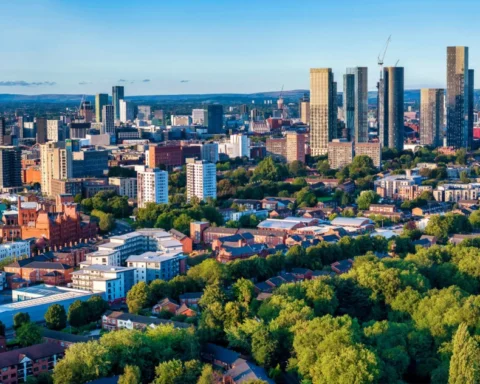
Monday, 9 February 2026 – MANCHESTER, England Regional leaders in the north of England have unveiled a bold plan to bring the Olympic Games to multiple cities across the region, challenging London’s historical dominance as the host city for major international sporting events. The proposal, discussed at a high‑profile meeting of northern mayors and officials last week, envisions an Olympic bid that would leverage sports infrastructure from Manchester to Newcastle and beyond.
Proponents say that spreading the Games across several northern cities would not only distribute economic opportunity more evenly across England but also ignite renewed investment in transport, housing, and community facilities.
A Unified Northern Vision Takes Shape
Andy Burnham, the mayor of Greater Manchester and one of the chief proponents of the bid, described the initiative as a “transformational moment” for the North. Speaking at a press briefing, Mr Burnham said the region has “the talent, the passion, and the readiness” to host a multi‑city Olympics that could rival the scale and spectacle of recent host cities abroad.
“We have world‑class venues already in place,” Burnham said. “From the Etihad Stadium to the arenas in Newcastle, Leeds, and Sheffield, we’re uniquely positioned to demonstrate how a distributed model can work efficiently and sustainably.”
Officials involved in the bid have held preliminary discussions with representatives from the British Olympic Association (BOA). While the BOA has not yet endorsed the concept, insiders say it has shown interest in exploring innovative approaches that align with evolving requirements from the International Olympic Committee (IOC).
Infrastructure, Investment, and Legacy Benefits
Supporters argue that a northern Olympics could catalyze new infrastructure investment in transport links that remain outdated in parts of the region. Proposed improvements include high‑speed rail enhancements, expanded metro networks, and targeted road upgrades to ensure seamless connectivity between host cities.
Economic analysts suggest that such investment could provide long‑lasting benefits beyond the Games themselves — incentivizing businesses to relocate or expand in northern hubs and offering new opportunities for local residents.
“We’ve seen how major sporting events can deliver a legacy of growth,” said a regional economist. “If planned properly, this bid could accelerate economic convergence between the North and the South.”
Civic leaders say they are also committed to embedding community engagement into the proposal, with programmes planned to boost youth sports participation, arts initiatives, and volunteer opportunities linked to the event’s cultural components.
Challenges and Skepticism
Despite enthusiasm from regional leaders, the bid is not without its critics. Some London politicians argue that the cost and coordination challenges of a multi‑city Olympics could outweigh its benefits, pointing to logistical complexity and potential overstretch of public resources.
A spokesperson for the London Assembly expressed caution, noting that “centralised planning and efficient delivery” have been hallmarks of successful previous Olympic hosts.
There are also concerns about ensuring equitable distribution of funding and resources across participating cities. Smaller municipalities fear that they could be overshadowed by larger northern metropolises unless governance structures are clearly defined.
International Olympic Committee’s Perspective
The IOC has increasingly signalled openness to non‑traditional hosting models in recent years. Sustainability and cost‑efficiency — including the use of existing facilities and regional collaboration — are key considerations as the body looks to modernize the Olympic movement.
An IOC representative, speaking on condition of anonymity, indicated that “innovative proposals that prioritize legacy and community impact are welcome” and emphasized that more detailed feasibility studies would be required before advancing to a formal candidacy phase.
A Growing Campaign With Global Ambitions
With the official bidding window for future Olympics approaching, northern leaders say they plan to accelerate consultations with national sports bodies, private sponsors, and community stakeholders. Should the bid move forward, detailed cost analyses and impact assessments are expected by late spring.
For now, the initiative has ignited spirited debate across the UK, drawing strong support in many northern communities and prompting discussions about regional identity, investment priorities, and Britain’s broader role on the world sporting stage.
As the campaign unfolds, observers will be watching whether this ambitious decentralised vision can bridge local pride with global competitiveness, bringing the Olympics to a new era of inclusive, multi‑city hosting.